
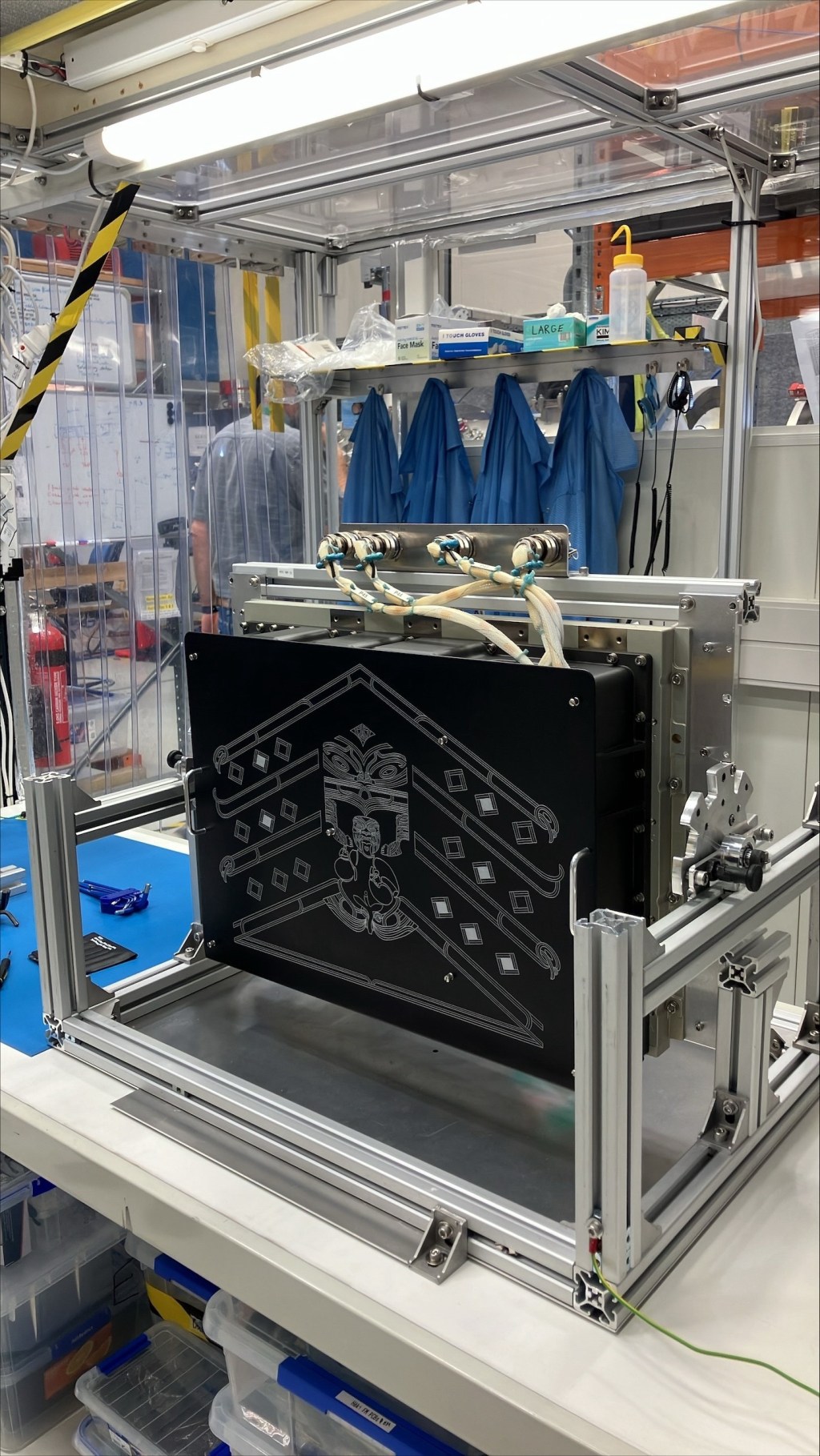
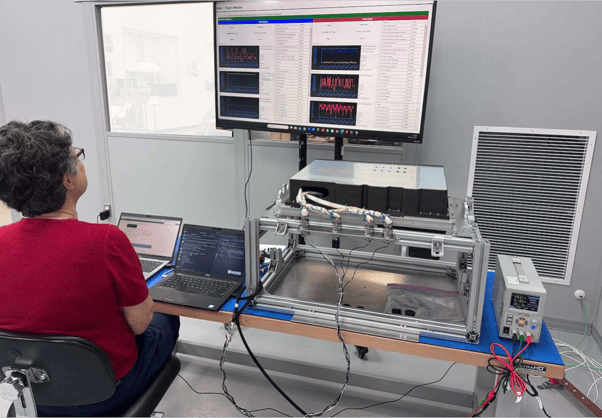
Since Hēki’s arrival back in our laboratory, we’ve completed some brief checks and inspections, and prepared for more comprehensive tests in a chamber simulating the near-vacuum environment outside of the International Space Station (ISS). These preparations included validating that our testing software, equipment, and facilities were all functioning as expected. The team used Hēki’s engineering model structure (described in this post) for this purpose. In parallel, we discussed and finalised test plans and procedures.
Today, our team installed Hēki onto the Hēki Emissive And Radiative Test (HEART) fixture in preparation for testing. HEART thermally isolates Hēki from its surroundings and serves to simulate the thermal environment that Hēki experienced on the exterior of the ISS, where heat generated by Hēki’s power consumption must be radiated away. See the figure below for details on HEART!
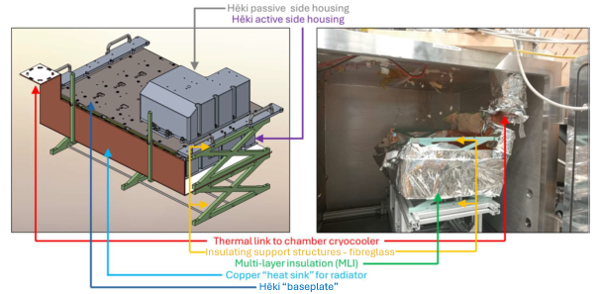
Left: computer-generated image showing Hēki Emissive And Radiative Test (HEART) fixture with Hēki installed. The image was created to aid in the design and development of the fixture. HEART is designed to thermally isolate Hēki from its support structure so that no conductive heat transfer occurs during test, so all heat must be shed via Hēki’s radiator (as in flight).
Right: Fit check of HEART fixture in vacuum chamber prior to installation of Hēki for testing. Silver-coloured multi-layer insulation shrouds the gap between HEART’s copper plate and the (soon-to-be-installed) Hēki to ensure all heat transfer is limited to Hēki’s active side radiator and the copper “heat sink” (which absorbs the radiated heat from Hēki). The heat sink is kept cold by an external chamber cryocooler (not to be confused with Hēki’s own cryocooler for the magnet, which is much smaller/lower power!).
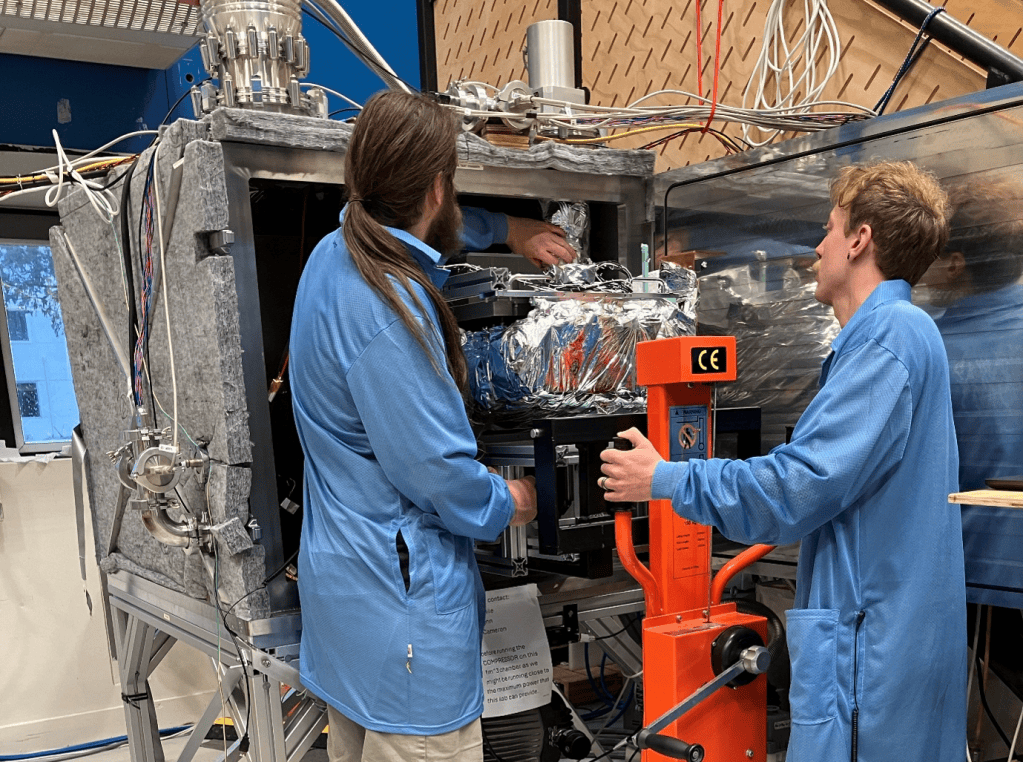
Once the installation was complete, our team moved the Hēki+HEART assembly to a chamber which simulates the vacuum of space (see header image). Over the next few days, we will complete some initial electrical and communications checkouts to ensure all the cables are correctly connected (and all systems functional!) before cooling Hēki to start post-flight functional testing.
Over the next few weeks, our test plans include repeating Hēki’s operations on the space station – turning on the electronics, radiation sensors, cryocooler, and charging the magnet with the flux pump to the maximum magnetic field from flight (500mT) and also reversing the polarity to -500mT. We’ll compare the rate at which the magnet charges to the rate before and during flight to look for any changes in performance. Once those activities are complete, we’ll experiment with operational parameters to optimise Hēki’s performance and confirm how high a field we can now achieve. Subsequent tests also include looking at the rate at which the magnet loses charge when the flux pump is turned off, as well as a detailed series of experiments to collect data during a controlled magnetic “quench”. These final tests will help us better understand how Hēki’s design responds as the energised magnet transitions from a superconducting to non-superconducting state as it warms.
Header image: in preparation for post-flight testing, members of the Hēki team move Hēki (installed on the HEART fixture) into a 1 cubic metre vacuum chamber which simulates the near-vacuum conditions on the exterior of the international space station. Our blue smocks help protect Hēki from unintended electrical shocks which might damage its electronics


Leave a Reply