
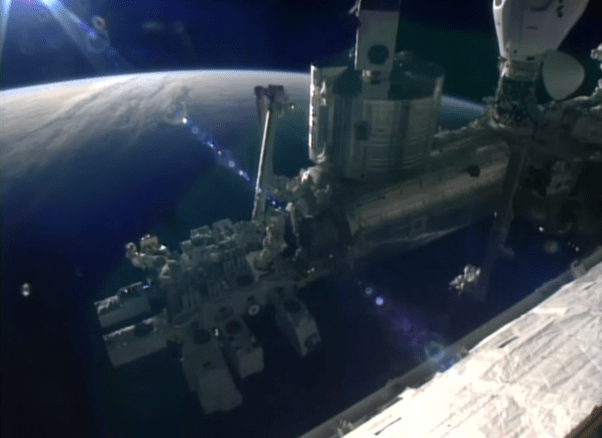
Today, we collected the last on-orbit data from Hēki just before the NanoRacks External Platform (NREP) hosting Hēki was powered down and removed from its the Japanese Experiment Module (JEM) docking location. Our team was then able to watch a NASA live stream showing Hēki being returned to the JEM airlock. Over the next few days, astronauts will repressurize the airlock and move the NREP into the ISS to separate Hēki from NREP. The crew will then pack Hēki so that it can be safely returned to Earth. NREP will then be aviailable to host future scientific experiments on the ISS.
In preparation for the removal, our team spent the past week monitoring Hēki’s temperatures to confirm whether Hēki’s formerly cryogenic components had warmed enough to avoid condensing water when exposed to the air inside the ISS. Hēki’s cryocooler and flux pump have been off during this time – with only the electronics powered – allowing the system temperatures to come to equilibrium with Hēki’s environment outside the ISS. Collection of this past weeks’ telemetry was made more challenging due to recent corruption of a memory card which stores long-term data in Hēki’s flight computer. Using similar computers in our lab, Hēki’s engineers were able to devise a work-around to access Hēki’s temperature data with the support of the the NREP payload mission management team at Voyager Technologies. Our team will further investigate the memory card issue when Hēki returns back to the lab to better understand it, but fortunately we had already downloaded all of the engineering and science telemetry collected before the memory card corruption occurred.
Hēki is tentatively scheduled to leave the ISS return to Earth in mid-2026. The Hēki team plans to complete simple post-return functional tests with Hēki at the Voyager Technologies’ facility in Houston prior to packing and shipping Hēki back to our laboratory at Paihau-Robinson Research Institute later this year. Hēki will then undergo a series of much more rigorous series of tests and assessments to characterise its performance after spaceflight. This testing will continue over the next year, completing the last of Hēki’s mission success critieria and providing crucial data on the feasibility of Hēki’s novel components for future space applications.
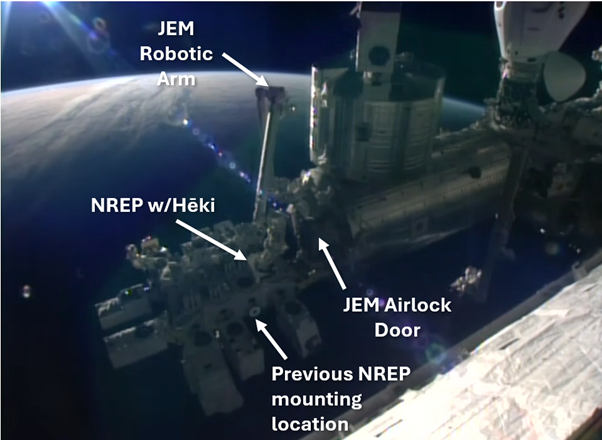
Image: annotated screenshot from NASA live feed showing Japanese Experiment Module (JEM) on the international space station (ISS), including the JEM-External Facility and the NanoRacks External Platform (NREP) mounting location. The NREP hosted Hēki during its mission. The JEM robotic arm was used to move the NREP from the JEM airlock to its mounting location in September 2025, and today it moved NREP back to the airlock. In coming days, the ISS crew will remove Hēki from the NREP and pack it so that Hēki can start its journey back to Earth. Header image is the same picture, with annotations removed. Image credit: NASA
 Paihau—Robinson Space Blog
Leave a comment