
Hēki has successfully completed all planned on-orbit commissioning (ie, initial check-out) activities and the team has transitioned to nominal mission operations.
After several days holding at the maximum planned magnetic field of 500milli-Tesla (mT), Hēki’s magnetic field setpoint was reduced to 300mT and then 100mT, with overnight holds at each field to confirm that the control system held the commanded field as expected. With those activities completed, the team commanded the flux pump to de-magnetize the system in preparation for the start of nominal operations. The demagnetization activity was successfully concluded yesterday, completing one of the required three magnetic field cycles we plan to demonstrate for our mission success criteria.
Today, we powered on Hēki’s radiation detector experiment again to start acquiring the data required to quantify magnetic field’s shielding effect on the on-orbit charged particle flux. Over the next two weeks, the operations team will ramp up Hēki’s magnetic field by 100mT per day to the maximum of 500mT, and then reduce it to 450mT, 350mT, … etc., and then back to zero mT. The data acquired at these different fields will address another of Hēki’s mission success criteria and is a vital part of our collaboration with researchers at the Czech Technical University in Prague.
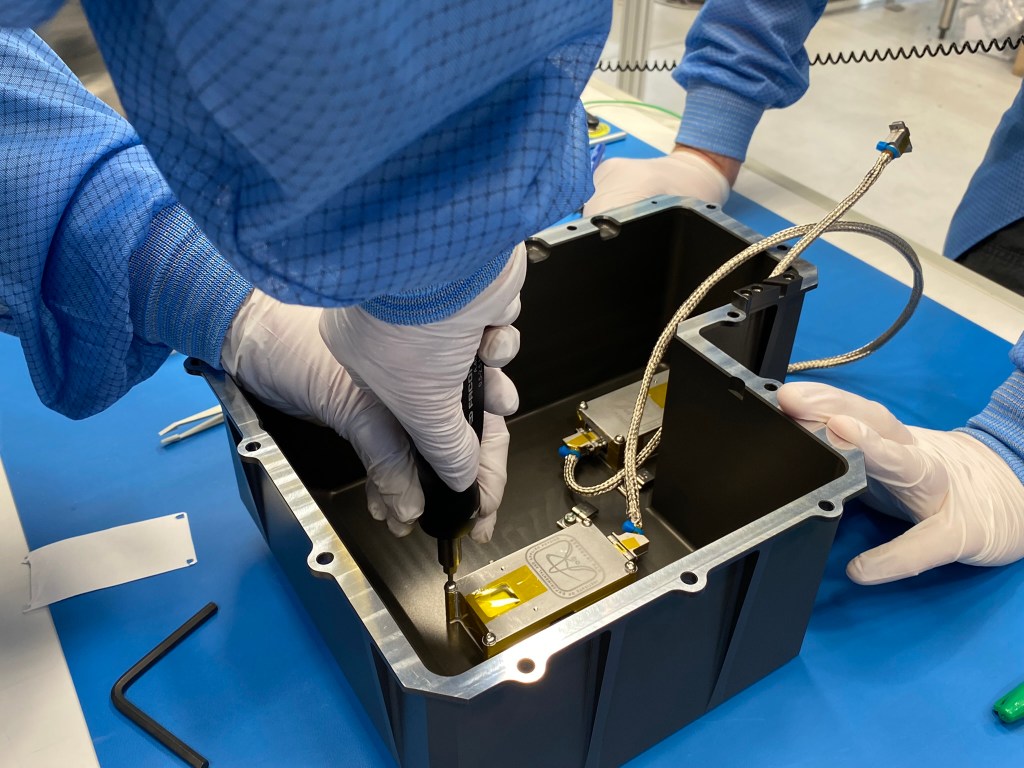
Header image: engineers install Hēki radiation detectors on aluminium housing which covers the magnet when Hēki is fully assembled.


Leave a Reply