
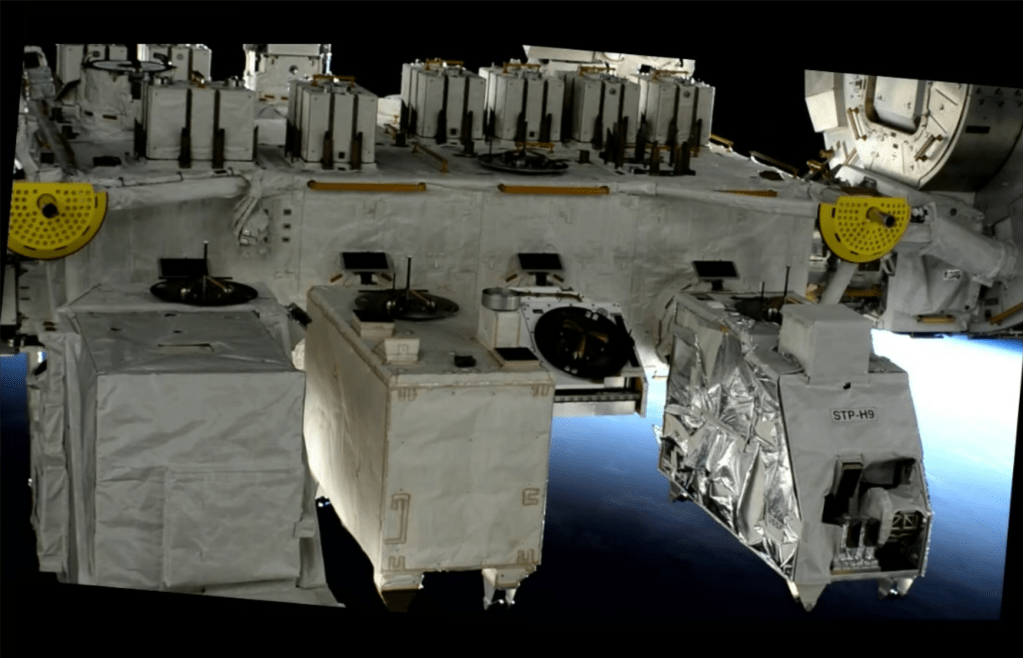
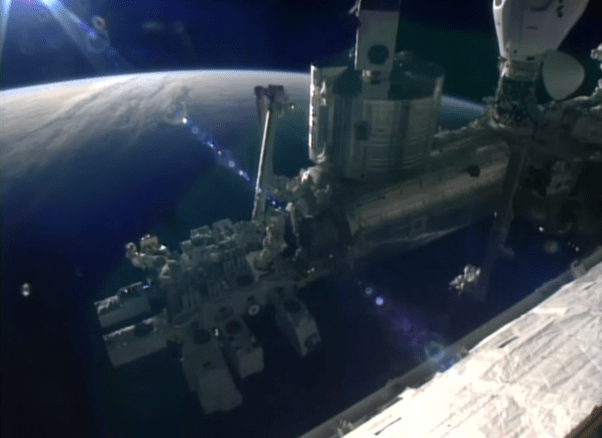
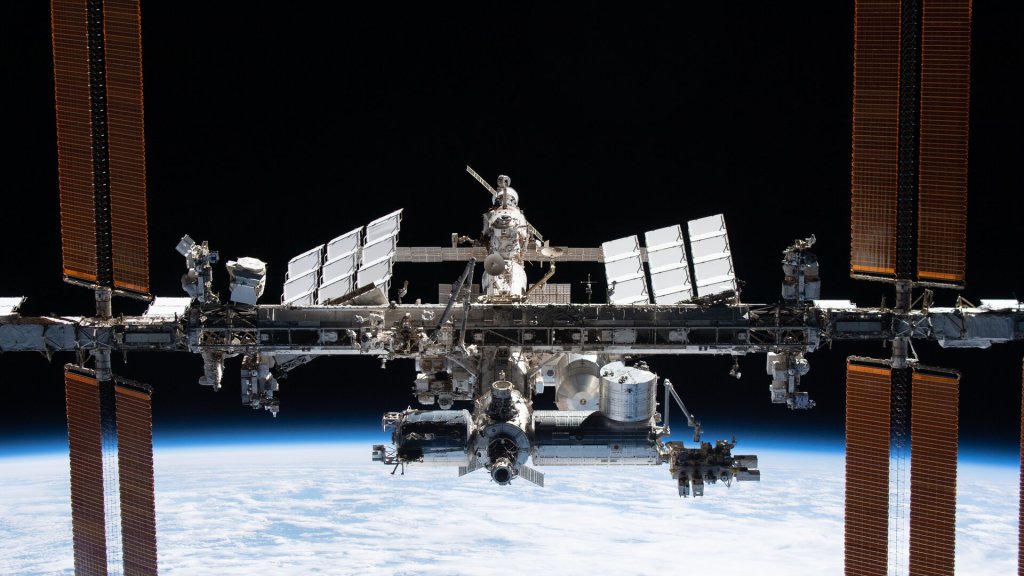
Today, the Japanese Experiment Module (JEM) robotic arm moved the Nanoracks External Platform (NREP) structure – including Hēki – from the JEM airlock to its mounting location on the Japanese Experiment Module External Facility (JEM-EF).
The mission management team at Voyager Technologies then powered on the NREP to configure it for the Hēki mission. The next activity was to power on Hēki itself, and we had a stressful (but expected!) 4 minute wait to confirm that Hēki was healthy and communicating with us. This is the first time we’d powered Hēki on since pre-launch checkout at Voyager Technologies in January! It also means we have now met the 6th of our 12 mission goals:
| Before Launch | ||
| ✅ | 1 | Build low-power, superconducting magnet system |
| ✅ | 2 | Verify Hēki can survive journey to – and operations in – space |
| ✅ | 3 | Comply with NASA safety requirements |
| ✅ | 4 | Demonstrate successful communication between Hēki and space station computer simulator |
| ✅ | 5 | Verify Hēki team’s readiness for operations in space |
| In space | ||
| ✅ | 6 | Successfully power on after installation on space station |
| 7 | Verify magnet is cooled to superconducting temperature (-200C) | |
| 8 | Meet or exceed required magnetic field (300mT) | |
| 9 | Measure effectiveness of magnetic field as a shield for space radiation | |
| 10 | Demonstrate successful operation throughout the mission, including at least three magnetic field cycles | |
| After return to Earth | ||
| 11 | Characterize Hēki to determine if there has been any degradation in performance | |
| 12 | Repeat characterization after forcing a magnetic “quench” to show that Hēki can safely dissipate stored energy if superconductivity is lost. | |
Once we successfully received data from Hēki, we confirmed that the electronics temperatures were within a safe range. Much of our first day involved closely monitoring temperatures to ensure Hēki’s thermal design was performing as expected. Specifically, we needed to see how heat generated by the electronics was moved around and transferred away in the absence of air, and that temperatures were stabilizing over time. This process had been simulated with Hēki in a vacuum chamber in our laboratory before launch, but there are always unknown factors when simulating these effects. Verifying thermal performance in space is a crucial design validation step for the Hēki mission, and fortunately all temperatures were in safe ranges and stabilized in the first several hours. This thermal validation will continue as we move to operations with the cryocooler (used to cool the magnet to cryogenic temperatures) and the flux pump (used to charge the magnet) in the next few days. These activities dissipate more power and are expected to be more stressing cases for Hēki’s thermal design.
Next, we started Hēki’s radiation sensor subsystem to collect baseline data (ie, measure radiation flux with no magnetic field). This data will be used to refine the observational parameters for the sensors and improve the quality of science data collected as the mission proceeds. Finally, we downloaded some pre-launch test data as well as data from our first few hours operating in orbit.
Upcoming day 2 activities: more thermal monitoring, a brief checkout of the flux pump, and finally we will enable high-speed streaming telemetry from Hēki and power on Hēki’s cryocooler to begin cooling the magnet to cryogenic temperatures.

Image: Hēki/NREP (circled) installed on ISS Japanese Experiment Module External Facility (JEM-EF). The robotic arm that moved the NREP (+Hēki) from the airlock to its operating location is visible above.

 Paihau—Robinson Space Blog
Leave a comment