
Happy New Year!
Operations update:
Hēki completed several activities over the holidays, including two cycles of its magnetic field from 0 to 500mT and collection of radiation sensor data. As noted in a previous post, the platform hosting Hēki experienced an unexpected power loss on 19 December and then another about a week later. Fortunately, Hēki was designed to be resilient to such faults and its performance remained unchanged after both occurrences. This is an important validation of one of the mission’s success criteria, albeit one that the team had initially planned to check off after Hēki’s return to our lab!
The past two weeks have been dedicated to collecting important performance data for Hēki’s design team: specifically, measuring the rate at which Hēki’s magnetic field decays when the flux pump is no longer energising it. Last week the magnet was charged to 500mT prior to allowing the field to “decay”, and this week we started at 250mT before stopping the flux pumping. These data help our team characterise Hēki’s current behaviour and how successor designs might improve upon its performance.
Hēki’s extended mission begins:
This week marks the completion of Hēki’s primary mission: the 15-week mission duration our team had originally planned for… but also the start of our extended mission, scheduled to conclude in April 2026. This also the milestone where Hēki takes credit for achieving the remaining on-orbit mission success criteria, though of course we’re continuing the mission and analysis of the huge dataset we’re collecting will continue into 2026 and beyond.
With the extended mission time now available, Hēki’s science and engineering team has been busy planning the next set of activities. The extended mission is an opportunity for Hēki’s team to push the edges of the envelope a bit and characterise Hēki’s performance over a wider range of operating conditions. Some examples include investigating Hēki’s thermal design by making the flux pump and magnet as cold as possible and measuring how they perform, as well as exploring how changes to the flux pump’s operational parameters impact its efficiency. Our team is also planning a detailed series of experiments to collect data during a controlled magnetic quench – this will help us better understand how Hēki’s design responds as the energised magnet transitions from a superconducting to non-superconducting state when it warms. In parallel, we’ll continue to collect radiation sensor data as a function of magnetic field for the remainder of the mission.
Hēki Success Criteria
| Before Launch | ||
| ✅ | 1 | Build low-power, superconducting magnet system |
| ✅ | 2 | Verify Hēki can survive journey to – and operations in – space |
| ✅ | 3 | Comply with NASA safety requirements |
| ✅ | 4 | Demonstrate successful communication between Hēki and space station computer simulator |
| ✅ | 5 | Verify Hēki team’s readiness for operations in space |
| In space | ||
| ✅ | 6 | Successfully power on after installation on space station |
| ✅ | 7 | Verify magnet is cooled to superconducting temperature (-200C) |
| ✅ | 8 | Meet or exceed required magnetic field (300mT) |
| ✅ | 9 | Measure effectiveness of magnetic field as a shield for space radiation |
| ✅ | 10 | Demonstrate successful operation throughout the mission, including at least three magnetic field cycles |
| After return to Earth | ||
| 11 | Characterize Hēki to determine if there has been any degradation in performance | |
| ✅ | 12 | Repeat characterization after forcing a magnetic “quench” to show that Hēki can safely dissipate stored energy if superconductivity is lost. |
… and a round-up of some Hēki project interviews and articles!
15 Nov 2023: Our Changing World – Superconducting magnets and plasma rockets
02 May 2024: Satellite Thrusters at Paihau-Robinson Research Institute
20 Sep 2024: Superconductor destined for space mission being built in Lower Hutt shed
24 Feb 2025: Electric Propulsion Magnets Ready for Space Tests
15 Sep 2025: SpaceX rocket carries Lower Hutt-built experiment to ISS
16 Sep 2025: Lift-off: Victoria University’s Mission Hēki goes into orbit
19 Sep 2025: A world-first: Toi Māori launched into space
25 Sep 2025:Superconducting magnet launched to the International Space Station
09 Oct 2025: Kiwi engineers reach for the stars as space dreams take off
10 Nov 2025: Liftoff! A new generation of Kiwi space entrepreneurs
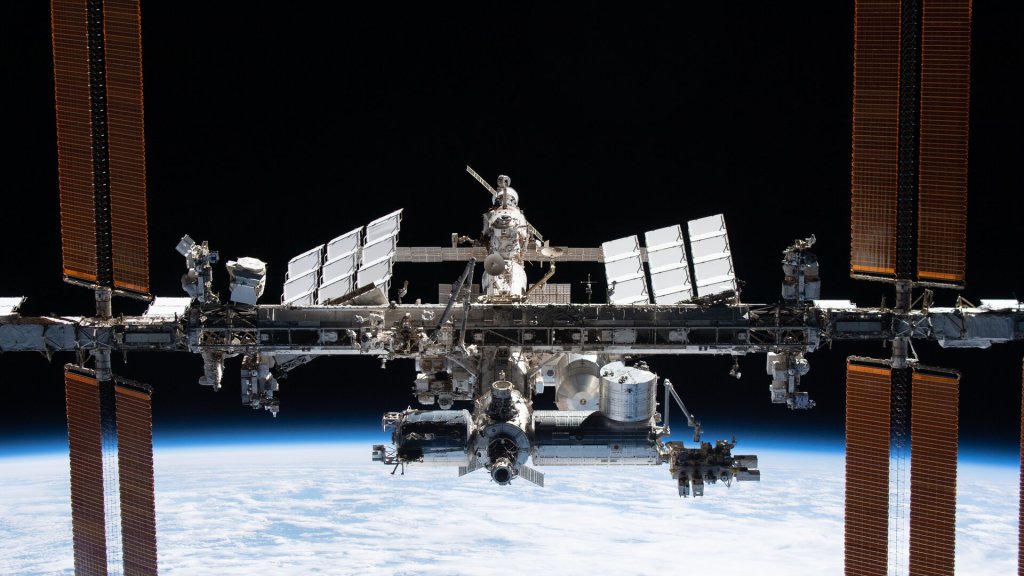
Header Image: the International Space Station, seen from space. The Japanese Experiment Module-External Facility is visible near the bottom of the image, just to the right of centre. Credit: ESA.
 Paihau—Robinson Space Blog
Leave a comment