
Operations Update:
Hēki continues operations over the holidays, testing our system’s ability to hold the maximum 500mT field for long durations.
Radiation Detector Experiment:
Hēki’s radiation detector experiment has now accumulated approximately 7 weeks of data. This data set is comprised of more than half a million 10 second measurements which capture several million individual radiation hits. These measurements have been collected at a variety of magnetic fields, and include increased activity associated with the 11-12 November solar flare event. This data is being analysed to determine how Hēki’s magnetic field affects the flux observed by the two detectors (one close to the magnet, and one farther away).
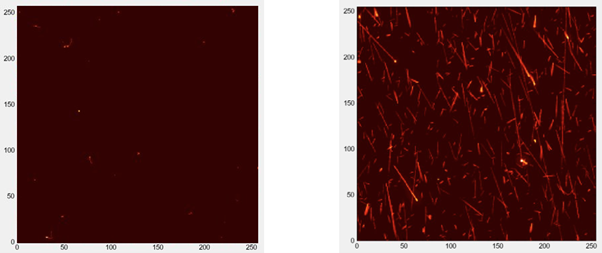
Image: radiation detector 10 second data acquisition during ground test (left) compared to radiation detector 10 second data acquisition in flight (right). Radiation “hits” appear as bright spots in the images. This clearly illustrates the radiation shielding provided by the Earth’s atmosphere and, to a lesser extent, magnetic field (the ISS is inside part of the Earth’s magnetic field so gains some of the benefit compared to deep space).
Our team’s modelling indicates that the magnetic shielding effect Hēki sees will be subtle, so a lot of data will need to be collected to generate meaningful statistics for analysis. Currently the team is processing the large data set already collected, classifying the different particle types observed, looking for correlations between the data observed at each sensor, and checking how the levels measured at each sensor compare in orbit location and time. In parallel, team has been able to confirm that Hēki’s software update has been effective in mitigating a temperature dependence in one of the detectors, an idiosyncrasy which would have made that sensor’s data challenging to interpret.
Hēki’s radiation detectors collect data on the radiation flux at the ISS as thermal conditions allow. They have been powered off over the holidays as the ISS orbit “beta angle” is decreasing, causing Hēki to warm due to increased sun exposure. The detectors will be powered on again to continue data collection in the new year, when Hēki spends more time in shadow and temperatures cool again.
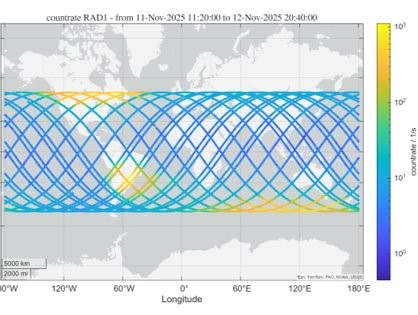
Header Image: radiation detector measurements shown along ISS orbit tracks during 11-12 November solar storm (image courtesy of Sebastian Hellman). Highest levels are shown in yellow, lowest in blue. Because of the shape of the Earth’s magnetic field, the poles receive a larger radiation flux than lower latitudes. This is why aurorae occur near the poles and not closer to the Equator. The flux is also elevated over the South Atlantic Anomaly feature, a known idiosyncrasy of Earth’s magnetic field. The ISS orbits at an inclination of approximately 51.6 degrees, which means that the plane of its orbit is tilted at 51.6 degrees compared to the Earth’s equator. This inclination is why the ISS’ ground track doesn’t extend further north or south than 51.6 degrees latitude.
 Paihau—Robinson Space Blog
Leave a comment