

Hēki’s software needed additional capability in order to maximise the quality of the data acquired by Hēki’s radiation detectors, so our team installed a new software version today. The updated software provides more flexibility when setting the radiation detector operational parameters, mitigating a dependence on temperature and other idiosyncrasies which would have made the data more challenging to interpret. Researchers discovered the need for this flexibility after Hēki had been packed for launch, and so the first opportunity to upload the improved software didn’t occur until after installation on the space station. During development of the new software version, Hēki’s engineers also took the opportunity to build in increased capability to handle faults, making future Hēki operations more reliable and robust to unexpected events.
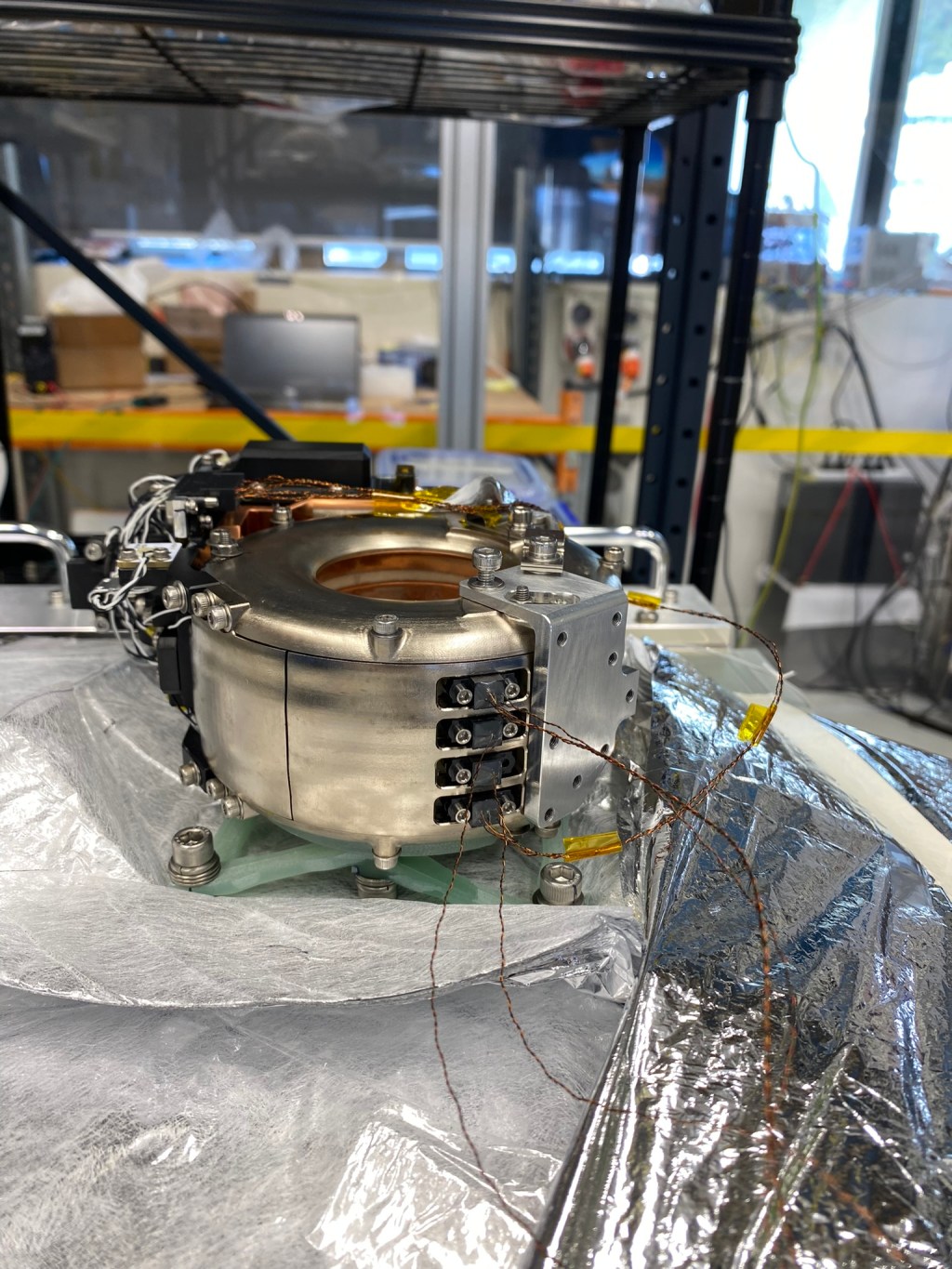
Updating Hēki’s software required a rigourous development and testing program using Hēki’s engineering model. The “EM” is Hēki’s ground-based twin. The EM serves as a testbed for the team – we can send the same commands we send to Hēki and receive representative data in response. It is located in our laboratory, inside a vacuum chamber which simulates the environment of space. The EM serves as a way to validate software changes or test commands that we plan to send to Hēki when Hēki is unavailable (as it was when packed in a box!) and without risking Hēki when we are trying something new.
Once our team had completed their testing of the new software on the EM, we submitted documentation on the software changes and test results to the mission management team at Voyager Technologies, who coordinated with NASA to review and approve the change.
To prepare for the software update, our team powered down Hēki’s cryocooler, flux pump, and radiation sensors, leaving only Hēki’s computer and electronics operating. Now that the software update is complete, our team has restarted Hēki’s cryocooler and radiation sensors. We plan to energise the magnet tomorrow when it reaches operational temperatures (about -200C) again.
We look forward to seeing the results in the radiation detector data acquired over the rest of the mission!
Header image: Operating station, power supplies, and 1m cubical stainless steel vacuum chamber housing Hēki’s engineering model in Space Team laboratory at Paihau-Robinson.
 Paihau—Robinson Space Blog
Leave a comment