

Hēki’s flux pump control algorithm setpoint was increased from 300 milli-Tesla (mT) to 500mT today and is holding steady at that field. This is the maximum planned magnetic field for the Hēki mission. The Hēki magnet achieved higher fields in pre-launch testing, but Hēki’s magentic field is limited to 500mT when operating on the ISS to avoid potential interference with other experiments around it.
The plan is to maintain this field for the next two days and then ramp back down to 300mT and then 100mT with one day holds at each field. When these operations are complete, the system will then be fully “de-magnetized”. These activities provide in-space validation of the magnet/flux pump and its control system (previously only tested in our lab).
Hēki’s magnet will be cycled from 0 to 500mT a minimum of two more times – this time with Hēki’s radiation detectors powered on – as part of meeting Hēki’s 9th and 10th mission success criteria.
Researchers will study the data from Hēki to compare its on-orbit and pre-launch performance and quantify any changes, and they will repeat the pre-launch testing in our lab to characterise its performance once Hēki’s mission on the ISS is complete.
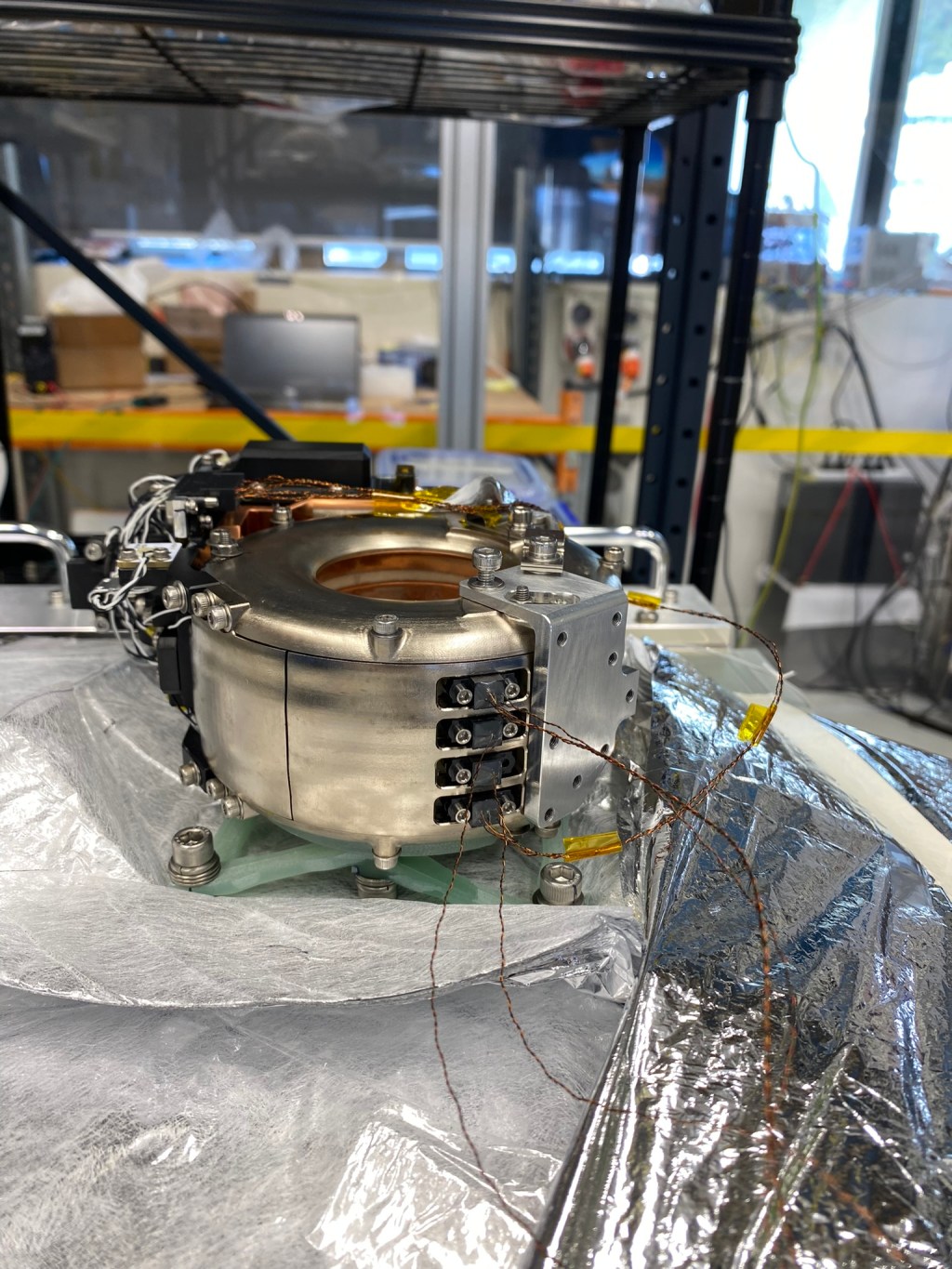
Header image caption: engineer preparing to wrap Hēki’s magnet in multi-layer insulation, which will enable the magnet to remain at cryogenic temperatures (approximately -200C) during operation.
 Paihau—Robinson Space Blog
Leave a comment