

The Hēki magnet met our 300 milli-Tesla (mT) mission success criterion during operations today. We will hold the magnet at this field for one day and then ramp up to 500mT tomorrow, the highest field planned for the mission.
Next week we will ramp the magnet back down to 0mT over several days, pausing at 300mT and 100mT on the way. This procedure will test the system Hēki’s team developed to maintain the field at specific setpoints.
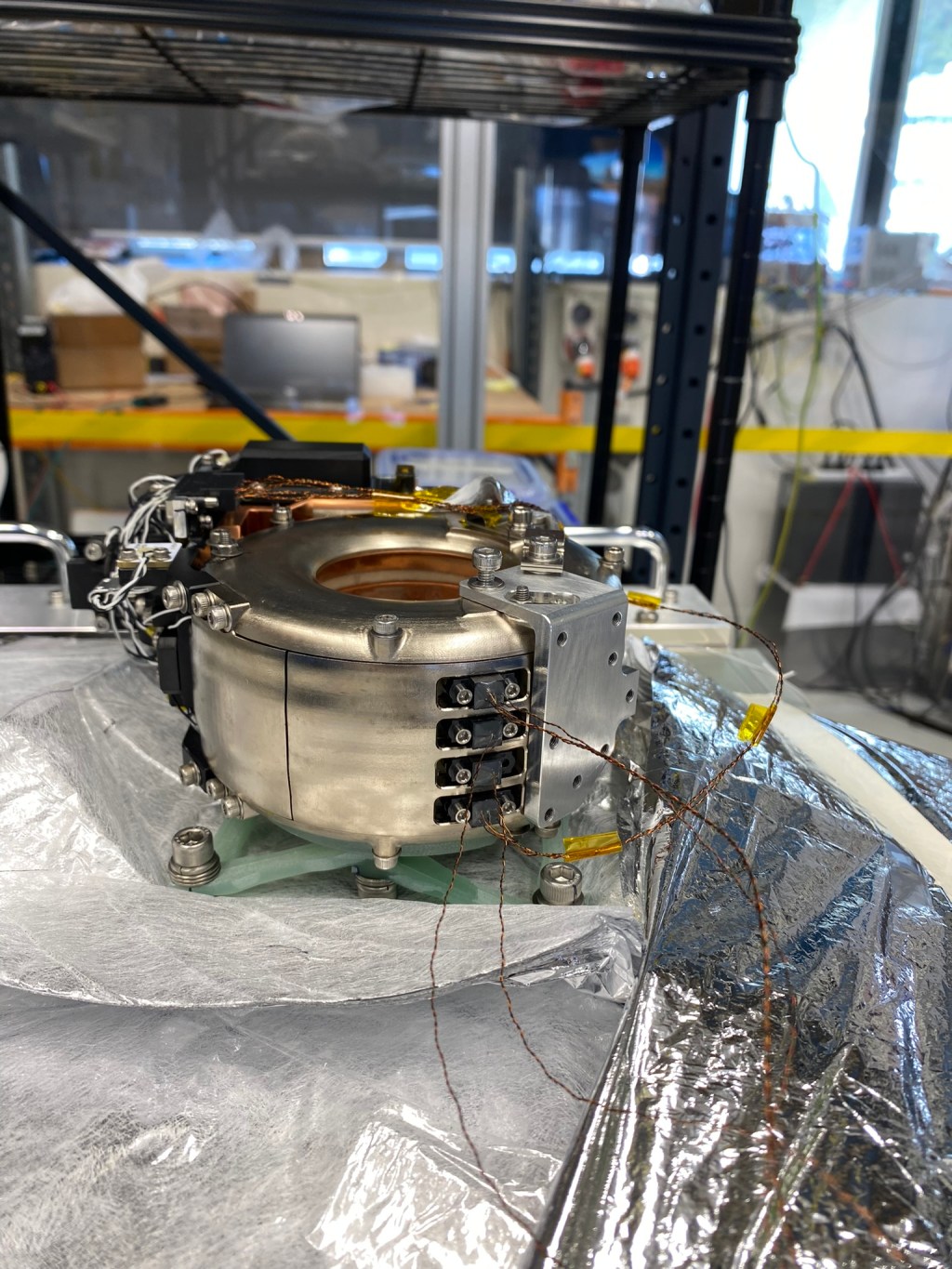
Header image: engineers test-fit Hēki’s “passive side” cover over magnet during integration. Prior to final installation, the magnet was wrapped in multi-layer insulation to enable it to maintain cryogenic temperatures during operations.

Image: plot of magnetic field at the centre of Hēki’s magnet, showing field increasing to 300mT from previous day’s setpoint of 100mT. Vertical axis is magnetic field in milli-Tesla, and horizontal axis is elapsed time. Gaps indicate times when space station real-time “downlink” – data flow from the ISS to the ground – was not available. These gaps in Hēki’s telemetry will be filled when Hēki’s on-board logs are downloaded later.
Hēki Success Criteria
| Before Launch | ||
| ✅ | 1 | Build low-power, superconducting magnet system |
| ✅ | 2 | Verify Hēki can survive journey to – and operations in – space |
| ✅ | 3 | Comply with NASA safety requirements |
| ✅ | 4 | Demonstrate successful communication between Hēki and space station computer simulator |
| ✅ | 5 | Verify Hēki team’s readiness for operations in space |
| In space | ||
| ✅ | 6 | Successfully power on after installation on space station |
| ✅ | 7 | Verify magnet is cooled to superconducting temperature (-200C) |
| ✅ | 8 | Meet or exceed required magnetic field (300mT) |
| 9 | Measure effectiveness of magnetic field as a shield for space radiation | |
| 10 | Demonstrate successful operation throughout the mission, including at least three magnetic field cycles | |
| After return to Earth | ||
| 11 | Characterize Hēki to determine if there has been any degradation in performance | |
| 12 | Repeat characterization after forcing a magnetic “quench” to show that Hēki can safely dissipate stored energy if superconductivity is lost. | |
 Paihau—Robinson Space Blog
Leave a comment