

One the primary requirements for Hēki’s design was to figure out how to use a relatively small amount of power (<100 Watts) to accomplish our mission goals. The largest part of the power budget was for cooling the magnet to superconducting temperatures (about -200C). As anyone who owns a refrigerator knows, making things cool takes a lot of energy! On the other hand: in order to maintain Hēki’s components at a constant temperature, the heat generated by Hēki’s energy use needs to be efficiently conducted or radiated away. Designing and testing Hēki to ensure thermal stability in space was a significant challenge. As noted in this post, confirming that we’d gotten the the thermal design right has been a crucial part of early on-orbit operations.
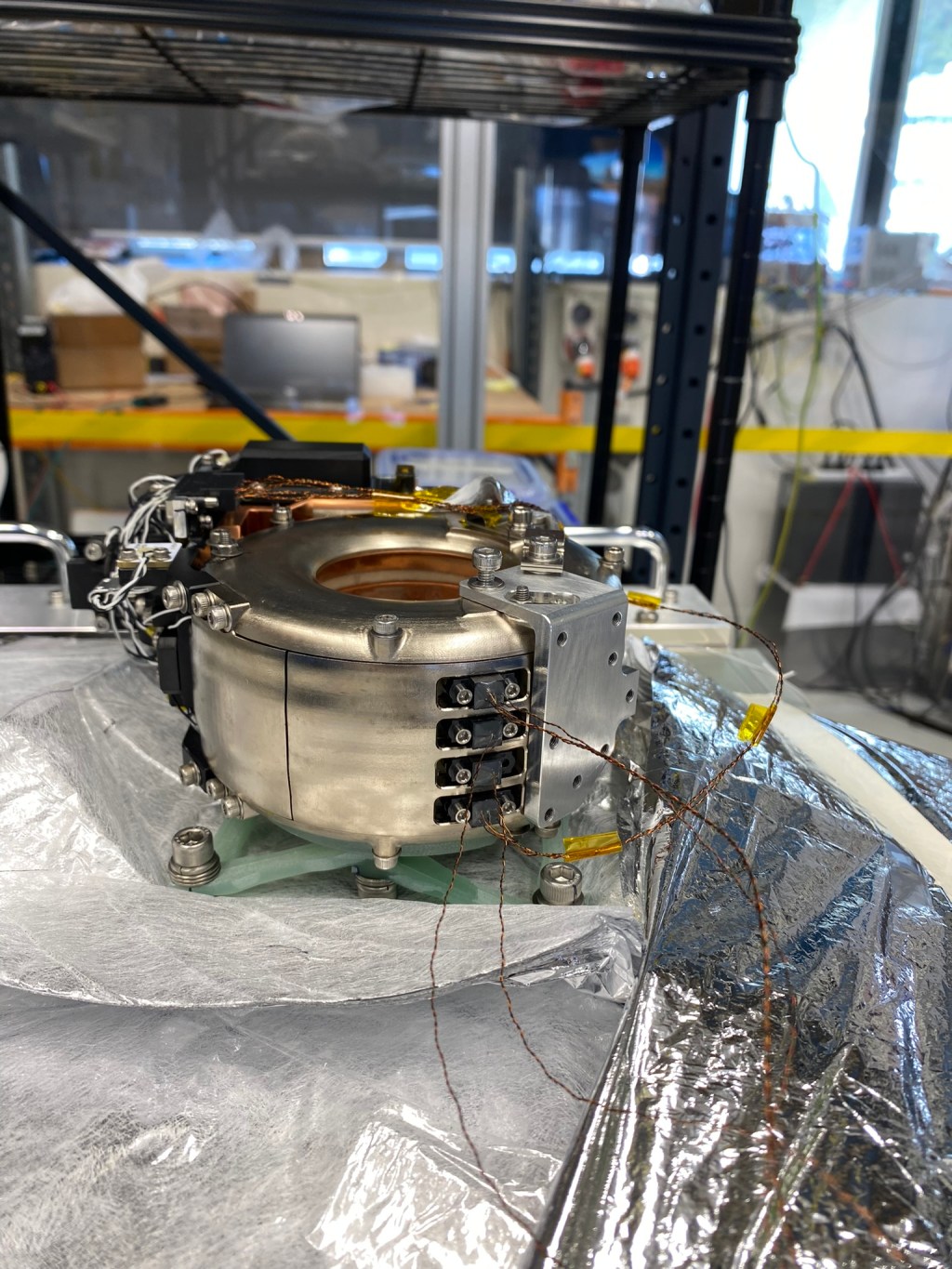
Hēki uses a mechanical device called a “cryocooler” to chill the magnet into its superconducting temperature range (see header photo, and below). Hēki’s cryocooler is a commercial off-the-shelf product about the size of a soda can. The cryocooler uses energy to move the heat from the magnet to Hēki’s radiator, where it can radiated away, keeping Hēki’s components at a stable temperature.
Today we are able to confirm that Hēki has achieved thermal stability with the magnet at superconducting temperatures – checking off #7 of of Hēki’s 12 crucial mission success criteria (below). Tomorrow, it will be time for Hēki’s flux pump to start energising the magnet!
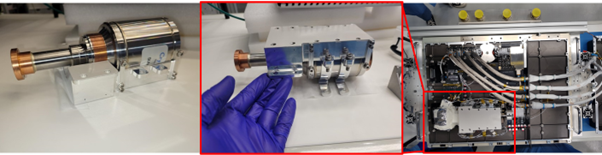
Left: Hēki’s cryocooler; Centre: Hēki’s cryocooler embedded in support structure; Right: interior of Hēki’s “active” (Earth-facing) side, showing cryocooler location during assembly. The cover with a reflective & emissive radiator surface was installed later in the assembly process.
Hēki Success Criteria Tracking
| Before Launch | ||
| ✅ | 1 | Build low-power, superconducting magnet system |
| ✅ | 2 | Verify Hēki can survive journey to – and operations in – space |
| ✅ | 3 | Comply with NASA safety requirements |
| ✅ | 4 | Demonstrate successful communication between Hēki and space station computer simulator |
| ✅ | 5 | Verify Hēki team’s readiness for operations in space |
| In space | ||
| ✅ | 6 | Successfully power on after installation on space station |
| ✅ | 7 | Verify magnet is cooled to superconducting temperature (-200C) |
| 8 | Meet or exceed required magnetic field (300mT) | |
| 9 | Measure effectiveness of magnetic field as a shield for space radiation | |
| 10 | Demonstrate successful operation throughout the mission, including at least three magnetic field cycles | |
| After return to Earth | ||
| 11 | Characterize Hēki to determine if there has been any degradation in performance | |
| 12 | Repeat characterization after forcing a magnetic “quench” to show that Hēki can safely dissipate stored energy if superconductivity is lost. | |
 Paihau—Robinson Space Blog
Leave a comment