

Several years ago, our team had the idea to explore use of high temperature superconductors to advance electric propulsion technology. This work led to successful demonstration of their novel concepts in the laboratory, with refinements and new work ongoing today.
We were gifted the name ‘Kōkako’ for this research effort by Rawinia Higgins (Tūhoe), the Deputy Vice-Chancellor Māori at Te Herenga Waka/Victoria University of Wellington. The inspiration was that the thruster will enable flight and its blue glow evokes the blue wattle of the kōkako.

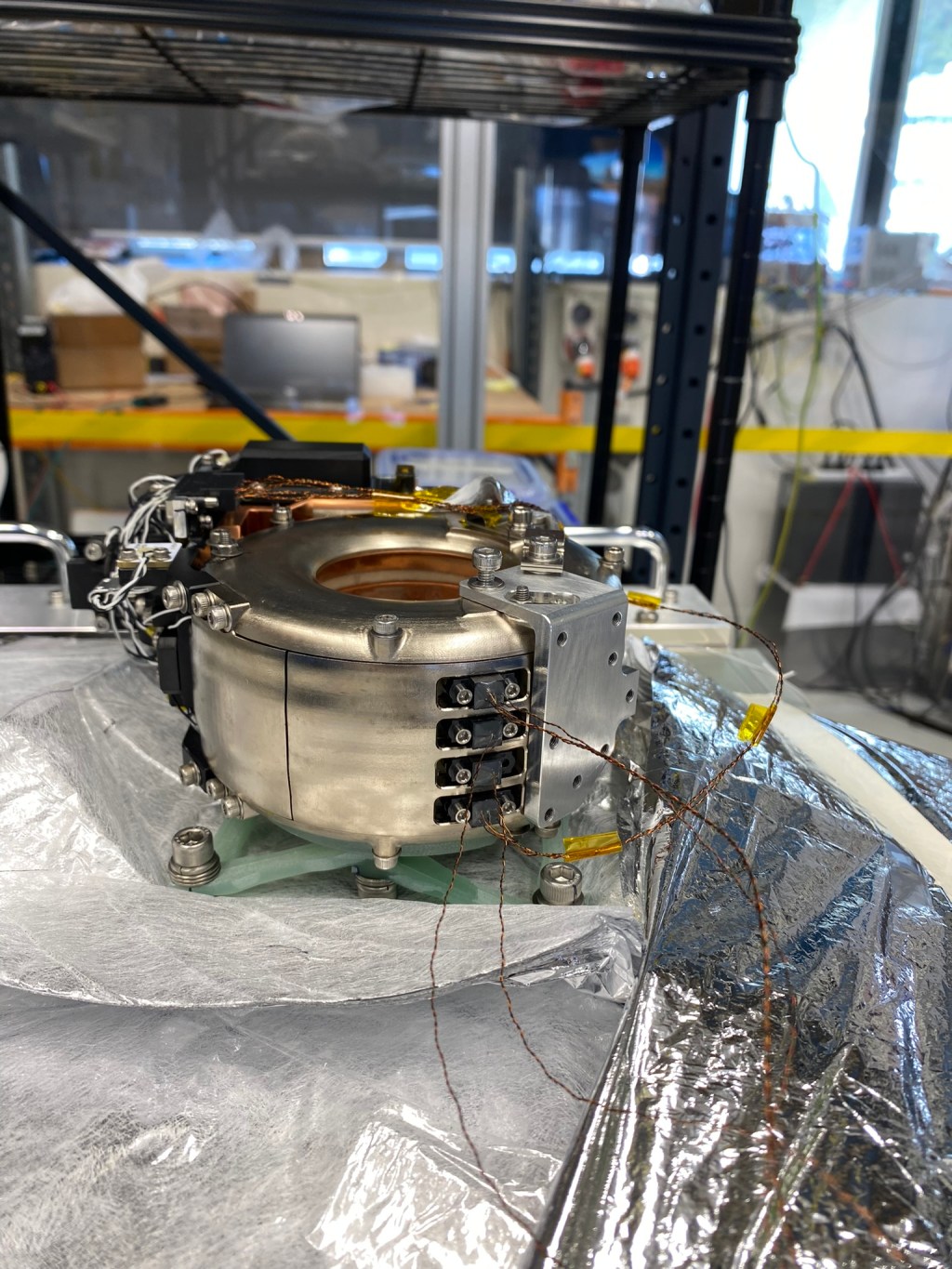
In parallel, this team designed and built a technology demonstration to validate that the novel components of this system – the superconducting magnet and its “flux pump” power supply – could withstand the journey to and operations in space. This experiment was named Hēki (te reo Māori for “egg”), to symbolise its potential for growth and development. Hēki’s design requires a radiator to dissipate heat in the vacuum of space, and this radiator has a delicate thermal coating which requires a protective cover for launch. The team felt it appropriate to use this cover as a canvas to acknowledge the gift of the mission names. Team members Dr. Pauline Harris (Rongomaiwahine, Ngāti Kahungunu ki Wairoa, Ngāti Rakaipaaka) and Tane Butler (Ngāti Tūwharetoa, Ngāti Whitikaupeka, Ngāti Tamakōpiri) contacted Māori artist Reweti Arapere (Ngāti Tūwharetoa, Ngāti Raukawa, Ngāti Maniapoto, Ngāti Porou), who created the iconic design which was laser etched onto the protective cover.
Reweti describes the inspiration for the cover art:
The concept for this design is to represent the cosmological narrative on how Kōkako was gifted the blue wattle. The story is as follows.
Tane-Māhuta the atua (god) of the forest and the birds climbed the twelve heavens to seek the baskets of knowledge. When Tane was thirsty Kōkako flew to his aid with water. Tane then gifted Kōkako with the beautiful blue coloured wattles and a beautiful singing voice. My art work incorporates the rich history of oral tradition that informs and responds to the natural world. The bird profile form represents the four winds.
This work is aligned to the philosophy and research methodology of matauranga Māori that knowledge comes from the heavens. Rangiātea is known as the name of the house where the baskets of knowledge came from which roughly translates as AstroSpace or the galaxy.
A Te Ao Māori news story provides additional details about the art & artist.
 Paihau—Robinson Space Blog
Leave a comment